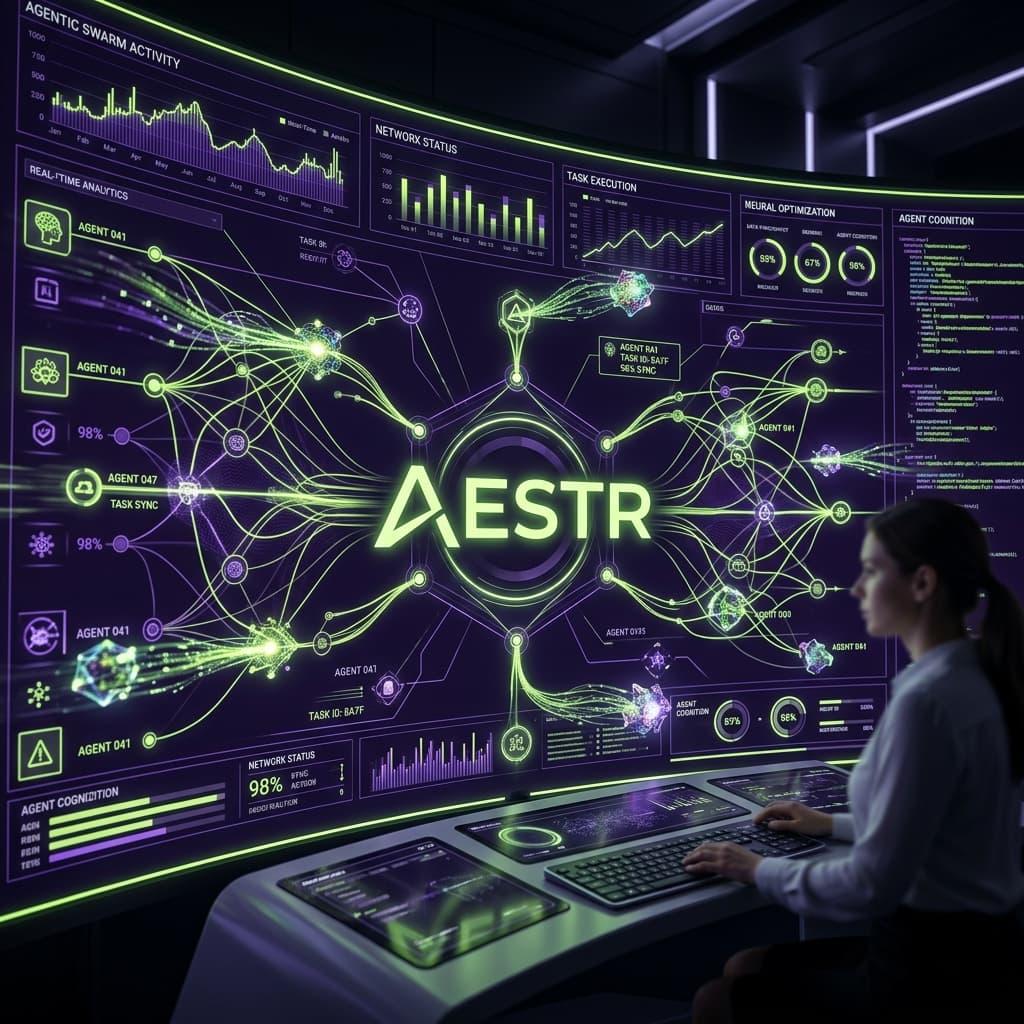
Executive Summary: The Great Shift to Autonomy
In the rapidly evolving landscape of artificial intelligence, we are witnessing a transition that is as significant as the invention of the internet itself. We are moving from "Generative AI"—systems that produce text or images based on prompts—to "Agentic AI"—systems that can reason, plan, use tools, and execute complex goals independently. This blog explores why Agentic AI is the next frontier of engineering and how the AESTR AI Program in Rajasthan is training the architects of this new era.
I. The Evolution of Digital Intelligence
To understand the future, we must look at the three distinct phases of AI evolution:
- Phase 1: Deterministic AI (The Rule-Followers): These were systems programmed with explicit "if-then" logic. They were great for playing chess or calculating logistics but failed in the face of ambiguity.
- Phase 2: Generative AI (The Content Creators): Large Language Models (LLMs) like GPT-4 revolutionized how we interact with information. They could generate creative content and summarize data, but they were fundamentally passive. They required a "human-in-the-loop" for every step of a process.
- Phase 3: Agentic AI (The Problem-Solvers): This is the current frontier. Agents are LLMs wrapped in a "reasoning loop." They can take a high-level goal like "Build a website for a local bakery," break it into sub-tasks, browse the web for inspiration, write the code, and deploy it to a server—all without human intervention.
II. The Anatomy of an Autonomous Agent
At **AESTR at SGVU**, we teach our residents that an AI Agent is more than just a model. It is a system composed of several critical modules:
1. The Core Reasoning Engine (The Brain)
This is the LLM that processes information. However, for Agentic workflows, the model needs to be optimized for "Instruction Following" and "Logical Consistency." In our AI Course in Jaipur, we experiment with fine-tuning models like Llama 3 for specific agentic tasks.
2. Planning and Decomposition
How does a machine handle a goal it has never seen before? Through planning. We utilize frameworks like Chain-of-Thought (CoT) and Tree-of-Thoughts (ToT). These allow the agent to simulate different paths to a solution and pick the most efficient one.
3. Tool-Use and API Interaction
An agent is useless if it can't interact with the world. We train our students to build "Tool-Calling" interfaces that allow agents to use calculators, search engines, and even external software like Salesforce or SAP. This is the heart of Artificial Intelligence Training in 2026.
4. Self-Correction and Memory
When an agent writes code that fails, it doesn't give up. It looks at the error message, reasons about what went wrong, and writes a fix. This "Self-Correction Loop" is what makes Agentic AI so powerful for software engineering.
III. The Socio-Economic Impact: The 2030 Tech Landscape
By 2030, the demand for traditional "boilerplate" coders will diminish. The high-value roles will be for "Agent Orchestrators"—engineers who can design, deploy, and manage fleets of AI agents. The AESTR Engineering Residency is specifically designed to fill this gap. We don't just teach you to code; we teach you to build the systems that code.
V. Conclusion: Join the Frontier
The rise of Agentic AI is an invitation to build. It is an opportunity for India to lead the next wave of global innovation. Whether you are a student, a professional, or a founder, the era of autonomy is here. Stop studying the past. Start architecting the future at the AESTR AI Program in Rajasthan.
Author's Note: This technical deep-dive is part of AESTR's mission to provide the most comprehensive AI Course in Jaipur, blending Silicon Valley research with Indian engineering grit.